Company Overview and History
Pinetree Capital (TSX: PNP) is a value-oriented investment company focused on enterprise software and technology. Unlike other serial acquirers I’ve covered, the company does not acquire a controlling stake in any of its investments. Pinetree applies value investing principles and assesses the intrinsic value of companies through qualitative and quantitative analysis, buying and selling investments depending on their share price and estimated intrinsic value.
What initially caught my attention about Pinetree was that it’s led by Damien Leonard, the son of Mark Leonard of Constellation Software. Many investors are likely unaware of the company due to its small market capitalization. After taking a closer look, I found the history of the company and its evolution to be a fascinating case study worth diving into for capital allocators.
First, a bit of background. Pinetree was not always focused on software and technology. For much of its history before Damien Leonard took over as CEO in 2017, it was an investment company focused on the small-cap market in resource sectors, including precious metals, uranium, base metals, and oil and gas. The approach at the time was to develop a macro view of those sectors and then identify opportunities within the sector, essentially a top-down investment approach.
If you look at historical share prices, you’d see evidence of many stock splits when share prices were much higher during 2006-2008 before collapsing by 2009, then again spiking in 2011 before falling in the subsequent years. The history here is interesting. In the mid-to-late 2000s, Pinetree rode the 2000s commodities boom, otherwise known as a commodities supercycle where prices for precious metals, uranium, base metals, and oil and gas skyrocketed.
For context, uranium spot price rose more than 10x from the early 2000s to its high in 2007. Gold prices also rose more than 275% during that period, while copper rose more than 400%. During this period, the market capitalization for Pinetree reached almost C$1 billion. However, the commodities market is notoriously cyclical, and this one was no different. Eventually, prices of many commodities crashed by more than 50% in the late 2000s. The 2008-09 global financial crisis exacerbated the situation as the global economy slowed.
For Pinetree, which invested in riskier small-cap resource companies, the result was devastating. For the twelve months ended 2008, it recorded a net investment loss of C$429 million. The company’s cost basis for its portfolio was C$600 million, and by the end of 2008, it fell 78% to C$134 million.
In 2009 and 2010, as the economy recovered from the financial crisis and commodity prices bottomed, the portfolio began to rise in value. It’s important to note that during this time, precious metals recovered quickly and even began making new highs in late 2009. This was a tailwind for Pinetree as its portfolio recovered its losses in 2010, with its precious metals holdings doubling in value.
Unfortunately, this was also short-lived. Gold hit a high in late 2011 and began a multi-year bear market, falling more than 40% from its peak and eventually bottoming in 2015. During that period, junior gold miners faced a brutal market. The VanEck Junior Gold Miners ETF, which tracks the MVIS Global Junior Miners Index, fell more than 88%.
Pinetree didn’t fare any better as the value of its total investments was almost wiped out by the end of 2016, with its balance sheet recording total assets of only C$11 million and an accumulated deficit of approximately C$412 million. But from the ashes of the original strategy, a new investment approach started to emerge.
This is where Damien Leonard stepped in. Leonard joined the company in November 2016 as its Chief Operating Officer, eventually taking over as the Chief Executive Officer in 2017. The company raised capital in 2016 and 2017 to pursue its current strategy of investing in software and technology companies.
I’ll be taking a slightly different approach from previous Spotlights by highlighting the company’s investment strategy, historical performance, leadership, and lessons investors and capital allocators can learn.
Key Facts
- Incorporated: 1962
- Investment business founded: 1992
- Headquarters: Toronto, Ontario
- Founder: Sheldon Inwentash
- President and CEO: Damien Leonard
- Employees: 3
- Industry: Software and technology
- Fiscal Year End: December 31
- Market Capitalization (September 16, 2026): C$86.92 million
- Book value per share (June 30, 2026): C$8.80
- Q2’FY26 TTM Expenses as Percentage of Book Value:3%
Pinetree Capital – Investment Approach
Below is a summary of Pinetree’s investment strategy based on its regulatory filings and information on the website:
- Asset class: Invests primarily in equities, as well as debt and convertible securities.
- Investment philosophy: The company adheres to its circle of competence by looking for opportunities in the technology sector, focused on providers of mission-critical software and services. The goal is to maximize the value of the portfolio without rigid requirements on weightings across verticals and geographies, growing Pinetree’s book value per share over the long term.
- Investment criteria: Pinetree aims to invest in mission-critical companies that operate in niche markets with decades of investment in their intellectual property. The company’s products should be deeply embedded in customer operations and have low churn. Ideally, the company should be run by managers with high integrity who have a track record of success in both operations and capital allocation, governed by a board that is aligned with the long-term shareholder interest.
- Assessment approach: Pinetree applies value investing principles and forms a long-term view of intrinsic value through quantitative and qualitative analysis, including fundamental analysis, reviewing regulatory filings, and interviewing management, employees, competitors, and customers. The company invests in businesses that trade at a deep discount to estimated intrinsic value, not ones that look statistically cheap on the surface. Pinetree then monitors its investments continuously and sells them when share prices reach or exceed management’s estimate of intrinsic value.
- Portfolio allocation: The company typically holds 8-12 investments. Individual positions may exceed 20% of assets, but board approval is required to initiate positions worth more than 10% of assets. Although the company can invest in private companies, only 1% of its portfolio is invested in private assets.
- Active involvement: Usually, Pinetree takes a hands-off approach after investing in companies. When needed, Pinetree will take a more active role by advising management teams on how to unlock value by providing strategic counsel in areas such as VMS operating best practices, capital allocation, corporate governance, and potential acquisitions and divestitures.
- Insider ownership: According to the most recent management information circular, Damien Leonard owns 33.8% of the shares outstanding while Peter Tolnai, who sits on Pinetree’s board, owns 8.0%. This high insider ownership creates strong alignment with shareholders.
Pinetree Capital – Holdings
December 31, 2025
|
Investee Name |
Investment Type |
Industry |
Geography |
Cost ($000’s) |
Fair Value ($000’s) |
% of Pinetree Portfolio |
% Ownership of Investee |
|
TruBridge Inc |
Equity – Public |
Healthcare Software |
United States |
15,513 |
25,712 |
28.8% |
5.8% |
|
Bravura Solutions Ltd |
Equity – Public |
Financial Services Software |
Australia |
7,379 |
21,522 |
24.1% |
2.0% |
|
Aptitude Software Group |
Equity – Public |
Finance/Accounting Software |
United Kingdom |
5,524 |
6,221 |
7.0% |
2.0% |
|
Dye & Durham Ltd |
Equity – Public |
Legal Software |
Canada |
7,502 |
5,287 |
5.9% |
2.0% |
|
Enghouse Systems Ltd |
Equity – Public |
Enterprise Software |
Canada |
5,471 |
4,479 |
5.0% |
0.4% |
|
Computer Modelling Group Ltd |
Equity – Public |
Oil & Gas Software |
Canada |
4,953 |
4,176 |
4.7% |
1.0% |
|
New Investment¹ |
Equity – Public |
Vertical Market Software |
Australia |
3,440 |
4,021 |
4.5% |
1.5% |
|
OMIDA AS |
Equity – Public |
Healthcare Software |
Norway |
2,712 |
3,955 |
4.4% |
3.0% |
|
Open Text Corp |
Equity – Public |
Information Management Software |
Canada |
1,250 |
1,475 |
1.7% |
0.0% |
|
Showbie Inc |
Equity – Private |
Education Software |
Canada |
1,000 |
1,000 |
1.1% |
3.9% |
|
Legacy Investments |
|
|
|
1,543 |
– |
0.0% |
0.0% |
|
|
|
|
56,288 |
77,847 |
87.0% |
|
- As at December 31, 2025, the Company held a new equity investment. The investee’s name has not been disclosed at this time while the Company evaluates whether to increase the size of this position.
December 31, 2024
|
Investee Name |
Investment Type |
Industry |
Geography |
Cost ($000’s) |
Fair Value ($000’s) |
% of Pinetree Portfolio |
% Ownership of Investee |
|
Bravura Solutions |
Equity – Public |
Financial Services Software |
Australia |
8,716 |
18,364 |
23.5% |
2.0% |
|
Trubridge Inc |
Equity – Public |
Healthcare Software |
United States |
7,286 |
17,564 |
22.5% |
4.3% |
|
Quorum Information |
Equity – Public |
Dealership software |
Canada |
5,788 |
7,600 |
9.7% |
10.9% |
|
Sygnity SA |
Equity – Public |
Vertical Market Software |
Poland |
822 |
6,527 |
8.3% |
1.2% |
|
Topicus |
Equity – Public |
Vertical Market Software |
Netherlands |
4,343 |
6,077 |
7.8% |
0.1% |
|
OMDA AS |
Equity – Public |
Healthcare Software |
Norway |
4,989 |
4,669 |
6.0% |
5.5% |
|
Aptitude Software |
Equity – Public |
Finance/Accounting Software |
United Kingdom |
3,073 |
3,862 |
4.9% |
1.1% |
|
Enghouse Systems |
Equity – Public |
Enterprise Software |
Canada |
2,902 |
2,709 |
3.5% |
1.1% |
|
Hansen Technologies |
Equity – Public |
Utilities Software |
Australia |
1,986 |
2,385 |
3.0% |
0.2% |
|
Sapiens International |
Equity – Public |
Insurance Software |
United States |
2,386 |
2,320 |
3.0% |
0.1% |
|
Showbie Inc |
Equity – Private |
Education Software |
Canada |
1,000 |
1,000 |
1.3% |
0.1% |
|
Legacy Investments |
|
|
|
2,890 |
– |
0.0% |
N/A |
|
|
|
|
46,181 |
73,077 |
93% |
|
Taking a closer look at Pinetree’s holdings and how they’ve shifted, it’s clear that the company is active in its investment approach and makes sizable changes in its portfolio composition. For example, Dye & Durham, which was not part of its portfolio in 2024, accounted for 5.9% of its portfolio in 2025. Likewise, other holdings were trimmed or added, with new additions and exits.
A more active approach can lead to a modest premium to book value if the company can consistently grow book value beyond investor expectations. Pinetree only discloses its full list of holdings at the end of every year. In their quarterly reports, the company only includes a breakdown of holdings by industry. Therefore, even if most of its holdings are publicly traded, investors would find it difficult to replicate the strategy on their own.
Pinetree Capital – Book Value Per Share and Premium/Discount to Share Price
In the table below, I’ve included Pinetree’s reported book value per share at the end of every quarter compared to its share price. The data series starts in the second quarter of 2017 because that was around the time when the company raised additional capital and Damien Leonard took over as CEO.
| Date | Book Value ($000s)1,2 | Adjusted Book Value Per Share | Share price3 | Premium or Discount |
| June 30, 2026 | 82,563 | 8.80 | 9.01 | 2.4% |
| March 31, 2026 | 68,584 | 7.31 | 8.37 | 14.5% |
| December 31, 2025 | 87,586 | 9.33 | 11.05 | 18.4% |
| September 30, 2025 | 88,674 | 9.45 | 12.46 | 31.9% |
| June 30, 2025 | 86,691 | 9.24 | 16.88 | 82.7% |
| March 31, 2025 | 88,375 | 9.41 | 15.00 | 59.4% |
| December 31, 2024 | 77,699 | 8.28 | 11.00 | 32.9% |
| September 30, 2024 | 60,339 | 6.43 | 7.50 | 16.6% |
| June 30, 2024 | 55,515 | 5.91 | 6.17 | 4.4% |
| March 31, 2024 | 56,485 | 6.02 | 5.69 | -5.5% |
| December 31, 2023 | 45,372 | 4.83 | 3.60 | -25.5% |
| September 30, 2023 | 41,399 | 4.41 | 4.06 | -7.9% |
| June 30, 2023 | 42,111 | 4.49 | 3.90 | -13.1% |
| March 31, 2023 | 39,056 | 4.16 | 3.58 | -13.9% |
| December 31, 2022 | 39,619 | 4.22 | 3.99 | -5.5% |
| September 30, 2022 | 36,550 | 3.89 | 3.08 | -20.8% |
| June 30, 2022 | 37,644 | 4.01 | 3.19 | -20.4% |
| March 31, 2022 | 35,779 | 3.81 | 4.49 | 17.8% |
| December 31, 2021 | 38,439 | 4.09 | 5.45 | 33.3% |
| September 30, 2021 | 38,547 | 4.11 | 4.59 | 11.7% |
| June 30, 2021 | 39,4803 | 4.19 | 4.00 | -4.5% |
| March 31, 2021 | 21,904 | 4.65 | 4.31 | -7.4% |
| December 31, 2020 | 19,101 | 4.22 | 2.80 | -33.7% |
| September 30, 2020 | 16,493 | 3.64 | 2.36 | -35.3% |
| June 30, 2020 | 15,399 | 3.40 | 1.97 | -42.1% |
| March 31, 2020 | 15,540 | 3.44 | 1.77 | -48.6% |
| December 31, 2019 | 17,898 | 3.96 | 2.84 | -28.4% |
| September 30, 2019 | 17,295 | 3.82 | 2.52 | -34.0% |
| June 30, 2019 | 17,350 | 3.84 | 2.82 | -26.6% |
| March 31, 2019 | 17,106 | 3.78 | 2.34 | -38.2% |
| December 31, 2018 | 15,980 | 3.53 | 2.32 | -34.4% |
| September 30, 2018 | 16,326 | 3.61 | 3.65 | 1.0% |
| June 30, 2018 | 18,925 | 4.18 | 4.27 | 2.1% |
| March 31, 2018 | 18,639 | 4.12 | 4.42 | 7.2% |
| December 31, 2017 | 18,305 | 4.05 | 4.79 | 18.3% |
| September 30, 2017 | 18,867 | 4.17 | 3.88 | -6.9% |
| June 30, 2017 | 18,839 | 4.17 | 3.94 | -5.4% |
Source: FactSet and company financial filings
- The “Book Value” used here consolidates other labels the company has used, including “Equity” and “Net asset value.”
- Note that there were some share splits/reverse splits and a capital raise in 2020-2021 that impacted the shares outstanding, and the book value per share has been adjusted accordingly to account for this.
- For share prices during holidays, the closest prior trading day closing price is used.
There are some interesting observations worth mentioning. First, there have been periods when shares traded at a substantial premium compared to the book value per share. Usually, these types of investment companies have what is known as a holding company discount because of the discount for control, the cost of running the company, and less transparency.
While Pinetree tended to trade at a discount to book value from 2017 to 2023, in recent years it’s traded at a premium. For instance, in mid-2025, the premium was almost the size of the entire book value. I’ve mentioned Pinetree’s more active investment approach in the prior section, but that still does not completely explain the significant premium in some quarters.
One reason why this might have been the case was due to the market environment at the time. It’s important to remember that software company valuations hit their peak in mid-2025. Pinetree also invested in a few companies like Sygnity that resulted in sizable gains during that period. Investors might have assumed that Pinetree would be able to tactically trade different names and compound value at a faster rate than a passive holding company.
The relatively small float of 9.4 million shares and the low trading volume likely exacerbated the situation, as the lack of liquidity drove prices in one direction during a strong uptrend. But high premiums to book value are rarely sustainable. During the SaaS-pocalypse bear market over the past year, the premium contracted to more reasonable levels. It’s a lesson for investors not to be overly optimistic about expected returns and that markets are not always efficient. Especially in the micro-cap space, where there are few institutional players, there can sometimes be large discrepancies between intrinsic value and current valuations.
Pinetree Capital – Returns vs. S&P/TSX Composite
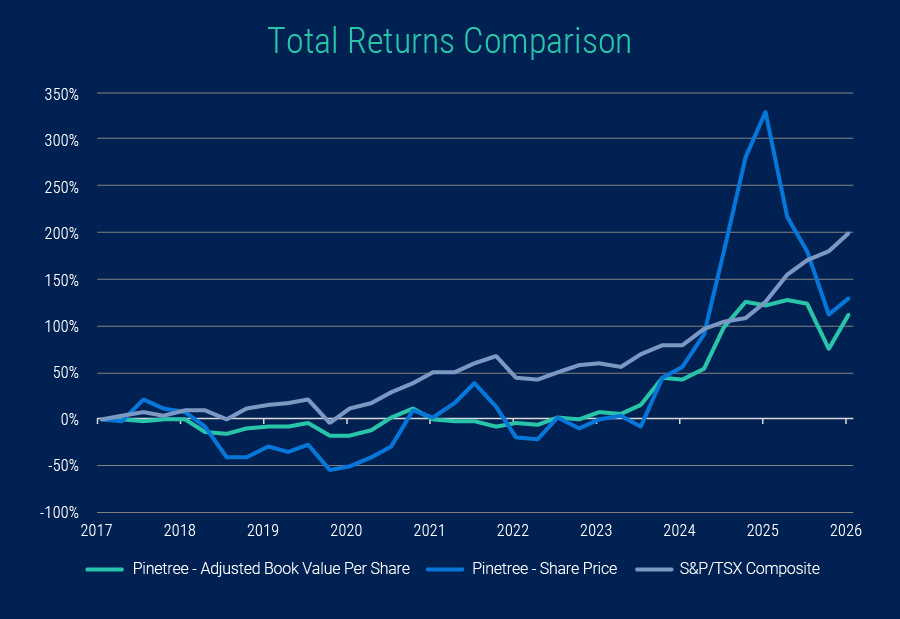
Source: FactSet and company financial filings
The graph above compares the total returns of Pinetree’s adjusted book value per share, share price, and the S&P/TSX Composite from June 30, 2017, until June 30, 2026.
For most of its history, both Pinetree’s book value per share and share price did not outperform the S&P/TSX Composite. The only exception was when share prices spiked from around C$4 in early 2024 to a high of C$24 in May 2025. But as the gap between the book value and share price shows, this was ultimately unsustainable and the premium contracted sharply.
Pinetree’s book value per share was also little changed between 2017 and 2023, hovering near 0% returns for the entire period, while the S&P/TSX Composite returned over 50%. It wasn’t like the industry was facing headwinds either. SaaS was growing quickly over this period, building up to hitting a peak between 2024 and 2025 when concerns about AI disruption would pressure valuations. Constellation Software, for instance, almost quadrupled in price over this stretch. Large-cap software names like Salesforce and Adobe also tripled in price.
While performance did eventually improve, this illustrates the difficulty and time needed for a team to build expertise and allocate capital effectively. This is . They have proven over time that they are able to execute and continuously compound capital. Therefore, it’s understandable why small-cap serial acquirers and capital allocators tend to trade at a discount compared to larger peers.
What is worth noting is that Pinetree’s book value per share did not fall nearly as much as other software serial acquirers during the recent SaaS-pocalypse. While names across the industry fell by more than 50%, Pinetree’s book value per share at June 30, 2026, was a healthy C$8.80 per share, down only 6.9% from the highest book value recorded on September 30, 2025. However, investors in the shares would not have benefited from this due to the premium contraction. Nevertheless, this is evidence of Pinetree’s active investment strategy at work.
Pinetree Capital – Costs and Deficit
| Date | Book Value ($000s)1 |
Operating Expenses ($000s) | Quarterly OpEx as % of Book Value |
| June 30, 2026 | 82,563 | 474 | 0.6 |
| March 31, 2026 | 68,584 | 526 | 0.8 |
| December 31, 2025 | 87,586 | 347 | 0.4 |
| September 30, 2025 | 88,674 | 497 | 0.5 |
| June 30, 2025 | 86,691 | 367 | 0.4 |
| March 31, 2025 | 88,375 | 429 | 0.5 |
| December 31, 2024 | 77,699 | 423 | 0.5 |
| September 30, 2024 | 60,339 | 178 | 0.3 |
| June 30, 2024 | 55,515 | 159 | 0.3 |
| March 31, 2024 | 56,485 | 179 | 0.3 |
| December 31, 2023 | 45,372 | 148 | 0.3 |
| September 30, 2023 | 41,399 | 190 | 0.5 |
| June 30, 2023 | 42,111 | 260 | 0.6 |
| March 31, 2023 | 39,056 | 283 | 0.7 |
| December 31, 2022 | 39,619 | 275 | 0.7 |
| September 30, 2022 | 36,550 | 293 | 0.8 |
| June 30, 2022 | 37,644 | 230 | 0.6 |
| March 31, 2022 | 35,779 | 337 | 0.9 |
| December 31, 2021 | 38,439 | 226 | 0.6 |
| September 30, 2021 | 38,547 | 263 | 0.7 |
| June 30, 2021 | 39,4801 | 216 | 0.5 |
| March 31, 2021 | 21,904 | 217 | 1.0 |
| December 31, 2020 | 19,101 | 132 | 0.7 |
| September 30, 2020 | 16,493 | 114 | 0.7 |
| June 30, 2020 | 15,399 | 121 | 0.8 |
| March 31, 2020 | 15,540 | 117 | 0.8 |
| December 31, 2019 | 17,898 | 155 | 0.9 |
| September 30, 2019 | 17,295 | 80 | 0.5 |
| June 30, 2019 | 17,350 | 118 | 0.7 |
| March 31, 2019 | 17,106 | 119 | 0.7 |
| December 31, 2018 | 15,980 | 103 | 0.6 |
| September 30, 2018 | 16,326 | 171 | 1.0 |
| June 30, 2018 | 18,925 | 121 | 0.6 |
| March 31, 2018 | 18,639 | 139 | 0.7 |
| December 31, 2017 | 18,305 | 195 | 1.1 |
| September 30, 2017 | 18,867 | 209 | 1.1 |
| June 30, 2017 | 18,8391 | 130 | 0.7 |
| March 31, 2017 | 10,154 | 246 | 2.4 |
| December 31, 2016 | 10,649 | 311 | 2.9 |
| September 30, 2016 | 11,481 | 265 | 2.3 |
| March 31, 2017 | 10,154 | 274 | 2.7 |
| December 31, 2016 | 10,649 | 286 | 2.7 |
| September 30, 2016 | 11,481 | 261 | 2.3 |
| June 30, 2016 | 12,327 | 1,938 | 15.7 |
| March 31, 2016 | 18,938 | 1,019 | 5.4 |
| December 31, 2015 | 19,502 | 734 | 3.8 |
| September 30, 2015 | 25,375 | 2,534 | 10.0 |
| June 30, 2015 | 39,686 | 1,506 | 3.8 |
- Note that there were some share splits/reverse splits and a capital raise in 2020-2021 that impacted book value. There was also a capital raise in 2017.
The table above shows the historical book value and quarterly operating expenses of the company as a percentage of book value. What’s clear is that after Damien Leonard took over as CEO in 2017 and capital was raised to pursue a new strategy, operating expenses per quarter as a percentage of book value have dropped over time.
Prior to 2017, operating expenses were about 2.5% per quarter, meaning investors were paying almost 10% per year for the company to pursue its investment strategy. In 2015 and 2016, expenses were even higher, sometimes in the double digits in a single quarter. For investors, such high expenses should have been a warning sign that the company’s structure was not in the best interests of the shareholders.
Even its current expense of 2% per year isn’t a small amount, especially when compared to low-cost broad market passive ETFs that charge less than 0.10% per year. Relatively high fees are part of the reason why hedge funds and other more expensive investment funds tend to underperform low-cost ETFs over the long run. The true top performers like Renaissance Technologies do outperform passive ETFs, but they generally don’t take outside capital. Even when they do, few investors can get access.
However, Pinetree Capital has one advantage that should not be overlooked. When the precious metals market crashed from 2011 to 2016, Pinetree recorded substantial capital losses. These losses have been carried as a deficit on its balance sheet. As of June 30, 2026, Pinetree has a deficit of C$367.9 million. Although the original shareholders effectively lost almost all their investment, investors today can potentially benefit from this deficit because capital gains today could be partially offset by this deficit, subject to accounting rules.
Pinetree Capital – Leadership Structure and Capabilities
Before discussing the leadership team, it’s important to note that Pinetree does not have many employees. Based on its management information circular, it only appears to have three employees: Damien Leonard, President & Director; Shezad Okhai, Chief Investment Officer; and John Bouffard, Chief Financial Officer. The board also consists of only three individuals: Craig Miller, Howard Riback, and Peter Tolnai.
Moreover, Damien Leonard is not paid any compensation, and the base salaries for both the CIO and the CFO are not excessive, with most of the compensation consisting of non-equity incentive plans in recent years. This lean structure helps keep costs low, which is something investors want to see.
Before leading Pinetree, Damien Leonard served as the managing director of L6 Holdings, a private family investment holding company, which focuses on making minority investments in public companies. L6 Holdings was involved this year in a private placement for Decisive Dividend, an . Like his father, Mark Leonard, Damien Leonard does not have much of a public presence, so it’s hard to find more information. However, based on his experience, Leonard has decades of experience allocating capital.
Prior to joining Pinetree, Shezad Okhai was the Vice President at Volaris Group, a subsidiary of Constellation Software. He was at Volaris for over ten years and was involved in M&A. There’s also a bit of an interesting background showing Pinetree’s active involvement in its investments.
In 2023, Okhai left Pinetree to become Bravura Solutions’ Chief Commercial Officer for one year to improve the company’s operating performance. At the time, shares were trading at C$0.50 after experiencing a brutal downtrend. The share price more than doubled during his tenure and, as of September 16, 2026, is hovering near its multi-year highs at around C$3.13. Currently, L6 Holdings and Pinetree own 22.8% of Bravura.
This is a good example of how the right leaders can turn companies around and the value Pinetree can bring to the table. Although it’s a small team, the experience they’ve built up over the past decade running Pinetree bodes well for shareholders in the years ahead.
Pinetree Capital – Lessons and Outlook
Below, I’ve noted some key takeaways after analyzing Pinetree:
- Every industry has its idiosyncrasies: Each industry has different fundamental drivers. For example, macroeconomic conditions create supercycles in the commodities market that result in lengthy bull and bear markets, while the software industry has generally seen steadier growth due to advancements in technology. Capital allocators should know the key factors to monitor for their industry and adjust their strategy accordingly.
- Market euphoria eventually normalizes: Although commodities and software are two completely different sectors, patterns of market euphoria and reset have been observed in both sectors. The length, duration, catalyst, and fundamentals may differ, but patterns of human psychology repeat in similar ways.
- It takes time to build a capital allocator: Even with experienced staff, it took Pinetree a better part of a decade to consistently grow book value per share. This explains why small-cap serial acquirers and capital allocators tend to trade at a sizable discount relative to more proven peers.
- Investment teams can be lean: Small investment teams can deliver value with the right expertise, especially in public markets where most information is publicly available. However, companies seeking private deals will likely need larger teams to conduct proper due diligence.
- Beating the market is no easy feat: While Pinetree outperformed the S&P/TSX Composite for a short period when the software industry hit its peak in 2025, it underperformed the index for most of its history. This is a reminder that the top long-term outperformers like Constellation Software are truly outliers.
With Pinetree’s active investment strategy, it’s difficult to predict how the company will perform. The management team’s ability to tactically trade and adjust their positions to take advantage of different opportunities can be just as important as the quality of the companies they’re investing in.
What’s encouraging is that book value per share has steadily been rising over the past three years or so, a markedly different trend compared to its early days in 2017 when Damien Leonard first joined. The company also primarily invests in micro-cap software companies, which could provide some diversification for investors who already hold well-known large-cap serial acquirers like Constellation Software, Topicus, and Lumine.
While investor sentiment around the software industry has improved in recent months, valuations are still below historical norms. Pinetree’s shares also no longer trade at a substantial premium. If there is an uplift in sentiment, there is the potential for sizable upside for Pinetree. I’ll be keeping a close eye on how the company performs in the quarters ahead and if it can continue to steadily grow book value per share.
Sources and References
- Website sources
- Investor relations: https://www.pinetreecapital.com/investors/stock-information/
- Investment approach: https://www.pinetreecapital.com/company/investment-approach/
- Press releases: https://www.pinetreecapital.com/news/
- Financial filings: https://www.pinetreecapital.com/investors/financial-reports/
- Source of financial and trading information: FactSet and company financial filings